Showing posts with label math games. Show all posts

Monday, July 29, 2024

Are You Ready for Your Early Finishers?

With so much to prepare as a new school year begins, getting a variety of good options ready to use for your early finishers is one of those things that unfortunately tends to slip lower and lower on your to-do list.


After all, there's always "read a book" or "go on your Chromebook". But are those kinds of very broad choices the optimal use of learning time for fast finishers? It's not that they're not good choices, but every learner needs and deserves more!


What do the strongest options for K-3 learners look like? 

* The best options reward students with the opportunity to choose. They have to think about what they'd like to do, think about what's a new choice or what they've already done and want to try again (or what they don't!). They gain confidence as they practice making choices. Choice requires thinking, choice is empowering.

Having a collection of games that will give your students choices is a great starting point!
Here's a set of addition within 20 games for first grade as an example. 

The set includes ten easy prep solo challenge games that are designed to be played by just one player - no waiting for a partner to complete their work!


Want to save this post? Just click the Pin It button!


You can find more solo challenge games for your fast finishers at these links!


                    First Grade Addition Games

                           First Grade Subtraction Games

                           First Grade Place Value Games

                           1st Grade Addition, Subtraction, Place Value Games Bundle


*  Look for options that allow your students to take what they've learned in class and extend it, learning more, for example, about the social studies or science topic you're teaching.

*  Seek out activities that your students can complete independently! Look for clearly written directions and activities in the same format as they've already completed as a class (color-by-code math pages, for example).


Let's look at a few options you might consider preparing today, before there's a little sweetie tapping on your hip saying, "What do I do now?" :)


1. Draw and Write: Prep a set of task cards or a chart list of people and/or places. Students who finish early can choose one or more cards and imagine a situation that places them together. Then they'll choose whether to illustrate and write a few sentences about the situation, or take a graphic novel / cartoon approach, writing the conversation between the characters.

Short on time and need some quick-and-easy prep task cards for this? Here's a set of 120 character and setting cards, available in both English and Spanish.


2.  Reading self-selected books is never a bad option, but consider getting more learning power from this by offering a collection of books that echo what you're currently teaching, as mentioned above. Your school librarian (pleeeease tell me that you still have a school librarian!) or public library will likely be able to help with suggestions!

For example, are you teaching the butterfly life cycle? Offer your early finishers choices from the books you've used as read alouds, or extend the opportunities to learn with something more advanced like a field guide to butterflies - there's so much to be learned from visuals, and pictures may be just what some students need to spark curiosity and learn more!


3. I mentioned color by code as an activity that works on repeat.  Another activity that will be used again and again is this math variation on word searches - sum searches through totals of 20. Print your word and number searches on cardstock and laminate - they'll get lots of repeat uses and you won't be running to the copy machine!


4.  Playing games is a fun and motivating way for early finishers (and ALL students!) to practice what they've learned. But it can get tricky if a student finishes and has no one to play a game with!

Look for activity type "games" that can be completed by just one person, like matching and sorting. 


5.  Offer a selection of puzzles and brain teasers that are so engaging that your students will think that they're playing, not practicing! 

One of my students' favorites was math riddle task cards, which are basically elimination riddles ... use math clues and critical thinking to eliminate all but one of the provided answer options.

I have TONS of math riddle sets in my store! If you click on these grade level bundles, you can scroll down on each to see the single topic sets that are included.


I hope these options will be helpful for you, and get you thinking of other choices that will be a good match for your fast finishers! 

Above all, make your options so enticing that they'll motivate all of your students to stay on task so they too can be part of the exciting activities that you've gathered!


Happy learning!


Friday, April 19, 2024

Kindergarten Math Fun for the End of the Year and Summer School

Will you be teaching summer school this year? 

It's tough to keep yourself going through the summer, but you and your summer school program are most definitely life-changers to those kiddos who desperately need the boost to be successful in the next school year!

It goes without saying that it's even harder to keep little learners motivated when ... hey, there are swimming pools and playgrounds calling their names!

So, what's the key?  Well, the key is the same thing as it is all year!


Keep the fun in learning!


The easiest way to keep learning fun? Teach with games! Need convincing of the benefits? Check this post!

You may find that some students joining you for summer school were also in your class this year, but chances are that a good number of your summer school students will be new to you. A new mix of students means it's time to go back and set your procedures and expectations. It's worth every minute of your time to do that!

Teaching your students to play partner games is a great way to reinforce positive classroom behaviors like...

    *  Taking turns
    *  Being patient with classmates
    *  Using kind and polite words
    *  Being gracious whether you win or lose a game
    *  Taking care of classroom materials when you're using them, and returning them to                 their assigned spots when finished (wouldn't that be an AMAZING thing to                           consistently see happening in your classroom??)
    *  Using appropriate voice volume level


Whether you're teaching kindergarteners going into first, kindergarten repeaters, or adding these games to your summer practice packets, here's a set of games that you'll love!


Each game is just one page, with no cards to print or prepare and... let's be honest, no cards to LOSE!


These games will give your students lots of practice building addition and subtraction fluency, like this Searching for Seashells game. Most of the games are ready to play with the addition of just dice and a way to mark the board, like erasable markers. A few, like this one, use a spinner. Add a spinner using a scrap of cardstock and a metal brad, or have your students create their own spinner each time they play with a pencil and a paper clip.


Your students will love games like Collect 20, and you'll like the multiple objectives that are being addressed each time they play  ... in this case, they'll name the shape, identify the number, count the pieces, recount them on each turn to reach 20, determine how many more they need to get to 20, and more!


Each game comes in both color and ink-saving black and white. What an easy and effective way to add fun activities to your summer send-home packet, especially if you've spent some time playing the games together during the last weeks of school!


How else are teachers using kindergarten practice games? Here are a few more ideas!


Are you ready for a closer look?


**********


Do you need easy prep kindergarten math games to use all year. like the set below? Try these!


Happy Teaching!


Monday, January 15, 2024

Quick & Easy Classroom Games for 100th Day and Valentines Day

Edit & repost from 1/11/13

Hi, Teaching Friends!

When I design games for your classroom, one of the objectives I try to keep in mind is convenience for you. Basically, I try not to have the requirements be anything more than print, laminate, and (sometimes!) cut! After all, the idea is to make your job easier, right?

Well, if you agree, I think you'll really like the simplicity of these two February resources!

First, there's an "I Have... Who Has...?" game for the 100th Day of School. (Does that get capitalized? I mean, it is a national holiday, isn't it?)  Simple to make: Print, cut the cards apart, and laminate if you choose. 

This version of "I Have... Who Has...?" goes beyond most simple versions of this game format. Your little learners will use a number grid to interpret 29 different numerical expressions for numbers as they relate to 100.  In other words, a card might read, "Who has 11 more than 100?" or "Who has 100-4?".  You might even differentiate by letting your mathematicians choose whether or not they need the support of the number grid or want to give it a go with mental math.


The second item is a set of print-and-play math games for Valentines Day. Five games. Print and laminate. Okay, two of them need to have paperclips put on to make the spinners. But, honest, that's it. As easy as it gets.


Ready for more February fun & freebies?  Check this post!


Happy Teaching!


Thursday, January 4, 2024

No Snow? No Problem! Snowy Classroom Activities

Just ask any kid - snow is the BEST! But depending on where you live, you may have students who never have ... and maybe never will ... experience all the fun that comes with a snowy day!

Well, you have the power to change that! Even if you can't take a class trip to the snowy mountains of Switzerland, here are some ideas for bringing snowy learning fun into your classroom... even if you teach in the tropics!


First up is the classic snowball fight game. 

This game has so many elements that kiddos love ...

*   Sitting on top of their desks
*   Ripping paper 
*   Crumpling paper
*   Throwing paper (or anything!)

You can find lots of variations on this by checking Google or YouTube, but here's the one that worked well with my first graders.

Have your students sit in two rows facing each other, or sit in a circle, either on the floor or sitting on top of their desks. Give each child a recording page (blank paper folded into 8 boxes works just fine) and a smaller paper (about 1/2 of a page is a good size - big enough for them to write on and still be able to have fun crumpling into a snowball).

Decide on your topic. We used this most often to build math fact fluency, so the topic might be sums of ten, subtraction within 20, doubles facts, etc.

How to play: Have your students write the equation (without the answer) on their small "snow paper" and crumple it to make a "snowball". Wait for the countdown... "3,2,1 - snowball fight!"  After all the snowballs have been thrown out into the middle of the group, send them out to each get one snowball (using teacherly tricks to maintain order as needed 😅). They write the equation on their recording page, solve it, crumple again, and get ready for round two!

TEACHING TIP: We all have students who have trouble getting started. Support them by generating a few examples together and displaying them on your whiteboard or interactive board. Encourage them to come up with their own equations, but leave the support visible for any students that might need it!


Next idea! Have you taken your class on a virtual field trip? 

What a great way to get some unique snow experiences! Try one of these snowy expeditions!

From Sesame Street kids, here's some up close and personal sledding fun! This would be a great opportunity for a mini-lesson about verbs.

Not exactly a field trip, but here's a walk in a snowy Canadian forest. Personally, I'd rather pick this lovely YouTube video than the classic fireplace one to use during a quiet reading or writing session.  


Here's the third idea to bring snowy fun into your teaching!

Books! Readalouds are an awesome way to get immersed in a snowy landscape! Books by Jan Brett are my personal favorite for this. I love the way her illustrations in books like The Mitten and The Hat draw you right into the snowy drifts.

Looking for non-fiction? My hands-down favorite is Snowflake Bentley, a Caldecott Award winner by Jacqueline Briggs MartinIt's the life story of the man who first photographed snowflakes. Some of William Bentley's actual photos are even included! My first graders absolutely loved this book. It's a great segue into teaching about perseverance and determination.

Search Amazon here for pages and pages of books about snow!

Do you need a book for shared reading? Here's a free book for K-1. Patterned text, strong picture/text match, and lots of high frequency words make Hey, Mr. Snowman a fun choice!
ESL / ELL teachers are finding this free book to be a good vocabulary builder for their students.


After you enjoy Hey, Mr. Snowman! together, you might enjoy using the activities in this set.


Lots of activities to extend the snowy learning fun!


The last suggestion for incorporating snow into your curriculum won't take even one extra minute from your busy day!


You're probably already using math games in your math centers and math tubs, so why not use games with snowy themes?

This game need absolutely NO PREP! The snowflake is from Dollar Tree, but you can just enlarge and print a copy. Then just add dominos. Click here to read about FIVE different ways to use this game, and to link to my friend Anne's blog where she's kindly provided more extensions with ten frames and higher numbers.


I have many (many, many 😊) winter activities in my TPT store - see them all here.

Here are three of my favorites!


Keep that snowflake fun going in your classroom, and you'll keep your students happily learning this winter!


Happy Teaching!


Saturday, December 4, 2021

3 Easy Prep Ideas for Fun December Learning

Keeping your students calm and learning in December without taking the joy out of a very exciting month is a huge challenge. Holiday crafts and Christmas Around the World activities are a ton of fun, and definitely have lots of learning value. But we all know that this is definitely not the year to let the pace of teaching curriculum slip, with so much time to be made up for!


Here are three ideas for holiday learning activities that your students can do independently, so you can continue to meet with small groups, or at least try your best! :)  All three of these activities are free, low prep, repeatable (use them again and again without extra preparation), and not one of these will leave you with papers to correct! 


They're also great as ready-to-go choices to add to your sub folder!


Let's get started!

Extra practice moving up and back on the 120 chart benefits nearly every first grader, and many second graders, too! This free set includes two games...


* Add one or add two
* Add one or add ten


How can you use these 120 chart games to keep your students practicing skills while you teach small groups? 

* December math centers
* Early finishers {When you're doing holiday craft projects, all of these activities will help your fast     finishers use their time productively!}
* Morning bins
* Fun Fridays


*******


Here's your next free math activity!  Head to your dollar store or craft store to pick up some big snowflakes, get out the dominoes that you probably already have, and you're ready to go! 

The post includes a variety of ideas to extend the use of this activity to use at different grade levels.


*******

Last on today's list of ideas is this making words activity, great for high first graders on up through fourth grade. Check out this post to find several other free gingerbread activities that you can use right on up through the grades!


Making words might at first glance look like just another puzzle activity, but the literacy benefits are actually huge!

Younger students will develop a greater awareness of spelling patterns and using the onset/rime principle in both reading and writing. ("If you can write bag, then you can write rag, nag, and brag.").  To introduce this activity, try modeling it on your interactive board with another holiday word. Think ornaments, mistletoe, celebration, etc.

* For older students, making word activities further develop onset/rime, work with prefixes and suffixes, and they're also a way to enrich vocabulary. When you click to the post, you'll see more about this.


*****

When the glitter and pipe cleaners and more glitter are flying, I hope these ideas will help bring some calm to your classroom while also keeping the fun in learning!


Friday, June 4, 2021

Start Summer with These Free Shark Math Games

Originally posted on Teaching Blog Roundup

Ah, summer! Here it comes! We may be lucky enough to be relaxing on the beach, gathering pretty shells, eating sandwiches with real sand in them. But our kiddos?  Always in search of adventure, they're thinking about SHARKS!  So it's definitely time to take advantage of that with these free shark math games!


It's hard to ignore the fascination kids have with sharks These free shark math games for kindergarten through third grade are a great way to put that enthusiasm to good use!


Here's a sample of the games directions that you'll find in this download!


The difficulty of these games ranges from "Fin It to Win It!" (arranging cards in numerical order) to "A Shark's Place" (two-digit place value) and on up to "Everybody Out of the Water!" (shown above), which has some trickier two-step directions, strategizing, and mental math.

Just a warning...  I had some pun-ny fun coming up with names for these games! The download also includes

* Shark Sighting
* One, Two, Three, Flip!
* Treasures of the Sea
* Sharks Alive, It's All About Five!
* Belly Up

Can't say I didn't warn you! :)

Your download includes number cards for 0-9 in both color and blackline (some of your students will love to color their own cards!) as well as the directions for eight math games.

These games would be a good match for your beach theme or ocean unit. Fun learning and easy prep for the last days of school, too! Use the same cards and try a new game every day!


If you're looking for more ocean-themed activities, this bundle might be just what you need! Click now to see it!


Happy Teaching!


Monday, January 13, 2020

Integrate Groundhog Day into Your Curriculum

Groundhog Day is a funny little celebration - not quite a holiday, but still an opportunity to learn something new and have some fun in the midst of a long winter. In view of how many other fun but time-consuming holidays are on the horizon in February, we all know that "the show must go on" - there's so much teaching and learning yet to be done! 

So, here are a few ideas to help you integrate Groundhog Day into your curriculum to save you time and maximize learning!


Celebrated since 1887, Groundhog Day has origins in ancient religious practices (Candlemas Day) as ancient weather lore, in which various other animals like badgers and bears were said to be good predictors of weather. If you're studying or have already studied weather in science, Groundhog Day is a good time to review vocabulary using riddles about weather.

Unscientific as the day may be as a predictor of spring, Groundhog Day is also a great opportunity to talk about shadows and how they change in length over the course of the day. 

A word of advice:  you might not want to do what I did one year long ago.  I worked with my first graders to create charts to observe and record how the length of a shadow changes over the course of several hours. We went outside four times (4!!! Boots, zippers, and all!) during the day, and they each worked with a partner to draw the length of their shadows on the sidewalk, using a different color chalk each time. Even though my class was very small that year, I really didn't think through how long the coats on / coats off routine was going to take each time, or how very excited this activity was going to get them.  I really think that they did learn a lot, they definitely got up and moving, and they got some extra fresh air.  Needless to say, I was exhausted at the end of that day!

Groundhog Day is also an appropriate time for a little side trip into talking about real vs. fantasy.  You can watch a one minute informational video of real groundhogs from The Science Museum of Virginia here to enrich your discussion.

Here's a free activity to add to your literacy centers for Groundhog Day.  Click here to see Grouchy Groundhog, a fun way to practice words that start with dr-, gr-, and tr- blends.


Here are a few math ideas for integrating Groundhog Day into your curriculum. 

One thing I like to do is share with my students that one of my granddaughters was born on 02-02-2020 and then ask what they notice about the date. Someone will eventually notice the palindrome pattern! Palindromes are just so cool, and every class seems to have at least one student who becomes fascinated with them.

Math logic riddles are a great way to enrich your curriculum and offer alternatives for your early finishers and advanced students. Try this free set of eight elimination riddle cards for Groundhog Day by clicking here!


The last two ideas for math are both from my TPT store.

The first is an extended set of riddles like those in the free set just above, but all completely different from the free ones. This set has 24 riddle cards, a board game that uses the cards, and the same riddles in printable worksheet format, handy for lesson warm-ups, exit tickets, and homework.  You can find it here.


If your students could use more practice on the very basic step of mentally finding ten more and ten less, and if they're ready to move beyond the concrete stage,  this might be just what you need! Click here for a closer look.


Keep the fun in learning, and have fun on Groundhog Day!

Happy Teaching!


Friday, November 22, 2019

Christmas Patchwork! A Creative Twist On Color by Code Subtraction

I love color by code math activities, and we all know that our students do, too. I mean, coloring, right? What more could a kid ask for?

Personally, what I don't love is the less than satisfying cookie cutter results. Plus, let's be honest, we know that some of our students are either peeking around to duplicate what everyone else's picture looks like or just coloring the picture to make it make sense. Pumpkins are orange and candy canes are red and white, right?

Well, not necessarily. Take a look at these Winter Patchwork activities. They're a creative twist on color by code math activities!


Whether it's played as a game with a partner or small group or independently, the math part is just basic fact practice: use two dice, roll and add or roll and subtract, according to the directions on the page.

So, what's the twist? Your students make their own choices of the colors they use!  A space labeled four could be colored pink, or green, or red, or any color ... and the next space labeled four could be a completely different color!  Giving choices means more confidence, more creativity, and more engagement - each work of art will be unique!

The same page can turn out completely different!


Patchwork math pages are a great opportunity to integrate art and math. Here are a few ideas for you to try.

* Take a few moments to talk about color choices before your students begin their patchwork page. Introduce art concepts like primary and secondary colors.  A color wheel (there are lots online) is a great tool for introducing complementary colors. Discuss the possibilities and encourage your students to commit to a set of colors before they start to roll and add or roll and subtract.

* Some students might like to try a page using just one color, but with a variety of shades, like lime green to pine green with everything in between!

* Of course, it's also fun to let your students create a crazy quilt of colors! Add an interesting challenge.  Can they complete the picture with no two spaces of the same color bordering each other?


Here's another twist that Patchwork math provides. It's not just a one time activity. 

*  You can laminate the finished pages to create addition and subtraction practice games for your December math centers. Put them into your centers with dice and some of those cute mini-erasers you've been collecting. Your students can play Bump, or Roll, Add/Subtract, Cover.  Student ownership means that motivation will be high!

*  Your students can cut out the shapes for a colorful display for a holiday bulletin board.  They'll also make a beautiful display on your classroom windows - they'll glow like stained glass when the sun shines through them.  The variety of colors will make your display unique and beautiful!


Would you like to try a free Christmas Patchwork page? This one will be especially fun if your students spend December looking for That Crazy Elf!  Just click to get your free download!


Happy Teaching!   


Friday, March 8, 2019

Pi Day Fun in the Primary Grades


Don't you just love a good math holiday, an event that reminds our students that math can be fun? Now that we've passed the 100th Day of School, the ultimate math teaching holiday, here comes Pi Day. For the primary grades, you ask? Well, the answer is yes! Here are some ideas for having Pi Day fun in the primary grades, too!

Of course, the math behind pi is tough stuff for our littles. but the idea of a number that goes on infinitely without repeating - well, we all know how they LOVE the idea of infinity and totally feel like big shots when they use the word! Plus, here's another fact I recently learned that you'll want to share with your little math aficionados: Pi contains every single possible combination of numbers - not just non-repeating, but totally random!

Here are a few quick ideas to help you introduce Pi Day to your students, and to be sure that they know that Pi isn't pie (although there are likely to be plenty of pies floating around schools at Pi Day celebrations!)

  • Get that "WOW" response from your primary students by showing them this display of the first 10,000 digits of pi on your interactive board, courtesy of UC Berkeley.
  • And then there's that decimal point. After you introduce the term, show your students how to read pi as "3-point-1-4-15-9-2-6", etc. It's also a great moment for making a connection with reading amounts of money, where the decimal point of course is read as "and". 


Because they're so hard to find, I've put together a set of Pi Day activities for the primary grades! 


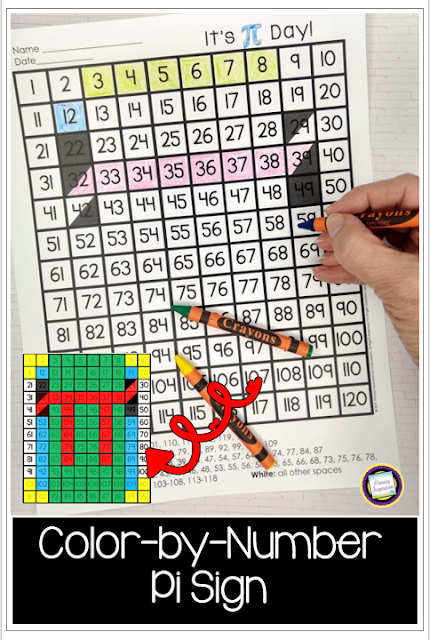
These activities are different from most that you'll see. First of all, these are all math activities that practice math skills, like addition, subtraction, and using the 120 chart.  They are not craftivities or coloring pages. There's a color-by-number pi sign page (lower left above), but then it turns into a (drum roll....) math game!

Let's take a closer look!

Here's the color-by-number activity.


If you have lots of time or plan to do several days of pi activities, have your students color the page using the code one day and use the completed pages to play the game the next day. But if you're short on time, just print copies of the answer key and use those as your game boards, along with the set of directions that's included.

You'll also find two 120 chart games in this set, "Happy Pi Day" and "PI, Not Pie!", both for practice with skills like add/subtract one and add/subtract ten. Games with hundred charts and 120 charts are good practice for our firsties.  These are games that you'll use long beyond Pi Day!

What else is in this Pi Day set? Two easy prep addition and subtraction games  - just print and add dice!


Click here or on any of the pictures above to see this set of six activities at my store.

Edit:  Here are some more Pi Day activities that use the 120 chart.  In the first game, your students will add and subtract ten from numbers 1-120, and then write the answer in the correct blank space on the chart.  Bringing up the level in the second game, students will add and subtract multiples of ten.

Click here or on the picture to see this set in my TpT store!


Happy Teaching!


Related Posts Plugin for WordPress, Blogger...