Showing posts with label place value. Show all posts

Wednesday, July 6, 2016

Winter Place Value Freebie!

Do you use clip cards?  They're always a popular and versatile math practice activity for little learners.


     * As a teacher of struggling first graders for more than ten years, I particularly value clip cards for their easy differentiation. Supplying three possible answers offers more support and makes the task just a bit easier than coming up with an answer with no support given.


     * Clip cards are also an easy tool to prepare and use in centers. Just print, snip, and you're ready to go! 


     * They're easy to make self-checking by using a sharpie pen to put a dot by the correct answer on the back of each card. Faster feedback and greater independence for your students, and no papers for you to correct!


     * A little more work on strengthening the pincer grip is never a bad thing! Try using clothespins or mini-binder clips to have your students build small motor skills while they're showing the correct answer.


Here's your winter math freebie! This set of math clip cards is a fun way to practice first grade and second grade place value, specifically with subtracting multiples of ten from two digit numbers. Click here to get your set!


This set of clip cards is also included in this larger math resource pack, Winter Math Games for First Grade and Second Grade.


Enjoy your freebie!


Friday, January 1, 2016

Keeping the PLAY in Place Value!

Hi, Teaching Friends!

This is often the time of year that place value teaching hits with full intensity in first grade - it hits teachers, and it hits our students, too!  As with most things we teach, some kids pick it up easily, others ... not so much.  If you're a new teacher and things aren't going smoothly, don't panic! Place value is among the earliest examples of an abstract math concept, and first grade brains aren't always ready for that big step!


To make things easier and definitely happier for everyone, let's keep the play in every stage of learning about place value!


I've gathered together some ideas and printables from blogs and Pinterest to help you as you guide your students from concrete to representational to abstract learning, all while keeping it fun!


Texture and colors make pipe cleaners pretty much an irresistible manipulative. Big and Small is a partner game from Smart First Graders that requires only two dice and a pile of pipe cleaners. To play, one player is designated as Big and the other as Small.  Using one roll of both dice, Big makes the greatest possible number and Small makes the smallest. This is a GREAT visual representation for comparing numbers based on place value! Be sure to check the same post for half a dozen more place value ideas for your firsties. { NOTE: The post at Smart First Graders has been updated. You won't find this exact game, but you will find five fun place value games!!}


Play Say It and Show It with this idea that the First Grade Fanatics have adapted from similar ideas on Pinterest. I like what they've added! Pull the cups apart to show the expanded form, push them together to read the number. Differentiate by starting with two cups for tens and ones, and then adding more up through thousands. This is great for building an understanding of place value and also for practice reading large numbers.


From Amy Lemons at Step into Second Grade, here's a place value activity with personal connections! Have your students build their names with longs and cubes. Then use printable base ten materials {free ones here, plus other place value goodies from Fun for Learning!} to turn these into a great math display!


Once your students are solidly into the abstract stage of learning about place value, you'll want to try this fun game from Games4Gains. This one is based on Yahtzee. I love working with games that students already have some familiarity with. If they've already played Yahtzee, recruit students to be your Experts. Putting one Expert in each group of players will make things so much easier for you! This set includes detailed instructions for use, plus free (differentiated!!) score cards. This is one that your students will definitely love!


After your students become confident at working with basic place value, there are of course more skills to master, and also more fun to be had!  Here's my gift for you today, a one page board game for practice with adding and subtracting tens to/from multiples of ten.  


The download includes both color and blackline versions. The black and white version is great to send home for family homework. Also included is a themed 120 chart, for students who need a bit of extra support. Click here or on the picture above to get your free game.


If you'd like more games like this one, here's a set of winter place value games for first grade. The games are each single page like the one above, and provided in both blackline and color. There's also a parent letter included, in case you'd like to send them home for extra practice.


 Happy Teaching!


Thursday, November 19, 2015

Winter Fun with Place Value Games

A good understanding of place value is the basis for success in so many other areas of math. Are you ready to freshen up your math centers for winter with some new ways to practice first grade place value standards?

I've just finished up a set of twenty winter-themed games that I think you'll love!


Here are the highlights:

*  Each of the games is just one page, with no cards to print and cut. Quick and easy!

*  Each game comes in two formats: color and grayscale. Read: save your ink! Even the color version has 20% or less color on each page.

*  Use these games in your math centers. Then copy the grayscale version to send home for family math. There's a letter included to explain it to the families.

* The games are packed with winter fun that your students love, like snowflakes, igloos, sledding, snowbirds, polar bears, and adorable winter kids!


Here's a quick peek at a few of the games.


Please stop by my TpT store  to find out more!


Happy Teaching!


Tuesday, December 9, 2014

Place Value Riddles for 2015 - a Freebie for You!

Hi, Teaching Friends!

Do you like to have some fresh new centers ready for your classroom before  you go on a break? Me, too! The first days back are always so exhausting, so doing something ahead of time is a little gift to yourself!

If you teach second through fourth grade, I hope you'll enjoy using this new year freebie in your math centers for January. It's a set of ten riddle task cards for four digit numbers. The twist is that each and every one of the answers uses only the numbers 2, 0, 1, and 5. Happy 2015!


  Click here to download it at my TpT store.
 
 
It's not too late to enter the giveaway at the My Favorite Things Blog Hop - 65 teachers have donated some amazing prizes, and they're all also offering their featured resources at 50% off this week! You can find the discounted items easily as TpT - just search #myfavoritethings2014!
 
 
http://primarypowers.blogspot.com/2014/12/fa-la-la-la-link-up-holiday-freebies.html


Happy Teaching!


http://www.teacherspayteachers.com/Product/Wonderful-Winter-Literacy-14-K-2-Center-Activities-169428

Tuesday, November 11, 2014

Place Value Work in First Grade

Hi, Teaching Friends!

This is Part 2 of a post about a very versatile resource from The Elementary Math Maniac, 0-120 Place Value Decks.

http://www.teacherspayteachers.com/Product/Numbers-to-120-place-value-decks-800015


If you missed Part 1 (kindergarten), you can see it here.
 
 
If I had to choose just one word to describe The Math Maniac's resources, I think I'd have to go with thorough. Tara is most definitely a deep thinker about the mathematical possibilities of her resources and the ways that using them will look with various levels of students. Drawing on her experience as a math specialist, the background information and suggestions for implementation that she provides are logical, practical, and comprehensive.
 
 
After using the card set you see above with my five year old PreK grandson (discussed in the previous post), I also spent some time with my seven year old granddaughter, who's a first grader.
 
 
M and I started out with some basic review of Base Ten models, doing some hands-on work with Legos, since there are about a million of them in her house! Then M pulled all of the number cards between one and 30 from the card deck  and then put them in order. She then did some matching of the Base Ten model cards to the numeral cards.


Next we moved on to addition. Again using the Legos to model, we spent a few moments modeling addition of a one-digit number to a two-digit number. Then we pulled the Base Ten representation cards and tried a few more of the same.
 
 
M seemed very comfortable doing all of this, so we moved right on to addition of 2 two-digit numbers. I love how the range and variety of the cards in this set allow you to make decisions like these on-the-go, responding to the needs of your students, a huge plus for your small group instruction in math.
 
 
I pulled number cards for M to add. She built models for 15 and 22, said "15 ..." and quickly discovered that grouping the ten sticks together and counting them all before counting the ones makes the process a whole lot easier. We practiced a few more addition examples that way, and then played a game.


Here's the record of what we did. To get the numbers to add, we rolled a 30-sided cube (head back to the previous post to see more fun with a a triacontahedron!) and a randomly-selected numeral card, and then took turns writing and solving the addition number models you see here. M came up with the idea of circling the sums to make it easier to compare the numbers in each row. Then she compared the numbers, marked the greater one with a check, and awarded a tally mark to the person whose sum was the greatest, marking it on the chart at the bottom of the page.


{The error in column one was discussed and fixed up after this photo was taken.}
 
 
In summary, M identified two digit numbers, sequenced them, built representational models of them, and developed a plan for adding them. Not bad for 15-20 minutes! And easily accomplished with just the card decks and one crazy die, which was a fun novelty but actually not even necessary to the success of the lesson.


Tara calls this card set the "hardest working thing (she's) ever made". I think you'll find yourself using these cards day after day, for whole class demos on your doc camera, small group teaching and exploration, and math center games. Every time the cards are used, your students ease in moving back and forth between the three representations will become more automatic.


The Math Maniac has included two things that will make this set very easy for you to use. First, there are links to some amazing blogposts loaded with ways to include these cards in your math instruction. Second, there is a very thorough list of all the relevant Common Core standards ... not just the number, but the whole standard, ready to copy and paste into your plans, for those of you that need to do that. Now, that's  added value!


I hope you'll take a closer look at these three card decks here at The Math Maniac's TpT store. If you are already using them, please share your favorite use in the comments below.


Happy Teaching!


Saturday, November 8, 2014

0-120 Place Value Decks from The Math Maniac

Hi, Teaching Friends!


I'm so excited today to have the opportunity to share with you a wonderful resource and some activities from Tara, The Math Maniac!


http://www.teacherspayteachers.com/Product/Numbers-to-120-place-value-decks-800015


In so many ways, the cards in this resource remind me of a big box of Legos.


* They're all the same, yet all different
* You pull out something different every time you reach in.
* You can use them in a different way every time you use them.
* The deeper you dig, the more ways you discover to use them.


The Math Maniac has worked for nine years as an elementary math specialist. Tara's approach is constructivist, with an emphasis on helping her students make connections between things they have learned. This resource is a wonderful tool to do just that!


She calls this set "the hardest working thing I have ever made", and I would agree that this is definitely an extremely versatile set. Like many of her resources, at first glance it's just a very simple
no-frills set.  After you print and cut the decks, there is little to no teacher prep required for the activities. 


Here's the Hidden Value to this resource: Tara has added in photos and some of the most thorough suggestions for implementation I've ever seen!


"Place Value Decks: Numbers to 120" consists of three card sets, all from one through 120: place value representations with corresponding numeral, place value representations without numerals, and numerals.


The product description and suggestions list it as suitable for K-3, and I put that to the test working with two of my grandchildren, ages 5 and 7.


Mr.E, age five, hasn't started kindergarten yet, but has a good grasp of early math concepts. He counts to 100, matches one-to-one in counting, counts by tens, and does simple addition and subtraction word problems in his head. Here's how we used the cards together.


We started with some sequencing of the numeral cards, emphasizing the teen numbers, and then doing a bit of review with pulling through the decades. After he arranged the cards in order, we practiced some counting up and counting back, with E pointing to the cards as he counted.


Then out came the Legos! We started building models for some of the numbers and then compared pairs of the Lego sticks, using math comparative words like longer/shorter, more/less, and greater number/lesser number.


We made models for 12 and 21, because the names of teen pairs (12/21, 13/31, etc.) are still not secure skills for him. Using the model and then bringing in the numeral cards to reinforce was helpful.


With the teen numbers, we talked about how easy it is to miscount when you use very long sticks of Legos, which made a simple segue into making sticks of ten blocks and then counting on by ones. We practiced this with several numbers in the teens and twenties. Since he's already able to count by tens, transitioning to counting on by ones was simple for him. Hopefully that will also be the case when we apply this to counting dimes and pennies some day soon! :)


Then we brought out the place value representation cards. Although E and I didn't go beyond 30, it was great to have all of the cards through 120 available, to make it easy to follow his lead and respond with both support and challenges as needed.


When E was very comfortable with going back and forth between the numerals, Lego models for numbers, and Base Ten cards, it was time for a game!


I put out a selection of some of the Base Ten cards between one and thirty. E named the number for each card and then lined them up in rows from least to greatest.  Then I brought out this extremely cool thirty-faced die! {What's the correct mathematical term for that, Elementary Math Maniac? ;) Whatever it is, every classroom needs a selection of great dice like this one!}  Edit: Tara tells me that it's a triacontahedron. It's more commonly known as a 30-hedron, but personally I think the long name is much cooler. Wouldn't some of your little ones enjoy tossing around a word like that? It's almost as good as Tyrannosaurus Rex!


We took turns rolling the die and checking the cards to see if the number we rolled was there. If it was, the player took the card. If not, the other player rolled. The first to get five cards won. So simple, but such good practice, and fun!


I love these cards - they make these spontaneous truly no-prep games a breeze!


This resource would be a wonderful choice for homeschoolers and math specialists because of the range of numbers, the many ways to use them, and the ease of differentiation for levels.

There are two more things that I consider to be major pluses for this card set:

1. There's a complete listing of the standards addressed - the whole standard, not just the number.
2. There are links to related blog posts for you to see the cards in use.

Click here to see 0-120 Place Value Decks at Tara's store. For second and third grade, try the Numbers to 1000 set!


Check out The Math Maniac's blog and Facebook page. Tara just completed a great book study, Chris Biffle's Whole Brain Teaching for Challenging Kids, and is always offering up some new and interesting insights on teaching math K-5.


Thanks so much for sharing this set with me, Tara!
Look for Part 2 of this post next week to see how I used the same set with E's big sister, age 7.


Happy Teaching!


Wednesday, August 13, 2014

Place Value Riddles for Three Digit Numbers ~ Free Sample!

Hi, Teaching Friends!

I'd like to introduce you to my latest math resource, which has taken a totally ridiculous amount of time to complete, as in months and months! The reason for that is that it has changed focus and direction more times than I can count, and I'm not even going to try to explain that. Here's what I finally settled on!


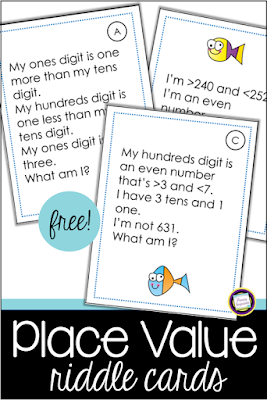
While these are called place value riddles, and there's mention of hundreds, tens, and ones in each of the fifty riddles, they are really more about operations, mental math, and reasoning. These two cards will give you a good idea of the types of clues and the difficulty range in this set.


Creating these riddles was fun, and using the Fun Fish graphics from Mel at Graphics From the Pond made it even more so! Are they the cutest or what?

 Click here or on this picture to see more details at my TpT store!


Would you like to try a few samples from the set? Click here or on the picture below this cover and enjoy!


Thanks for stopping by! Happy Teaching!


Monday, May 12, 2014

FREEBIE! Adding and Subtracting Multiples of Ten

Good Monday Morning, Teaching Friends!

Are you practicing adding and subtracting multiples of ten? Being able to do that quickly is a powerful tool for mental math, so here's a freebie for a bit more practice! 

Use as a follow-up to your lesson, for a fun homework assignment, a morning Do Now, or just pop it into a math center with a hundred chart for some bonus practice on this early place value skill!

Thank you to KPM Doodles for the sweet Zoofari animals.

Click here or on the picture to download your copy.


https://docs.google.com/file/d/0B8LaCTimmHFZcmxGN2UteVlKOTg/edit


Happy Teaching!


Friday, March 28, 2014

Yo-Ho! Bring on the Pirate Place Value!

Hi, Teaching Friends!

Isn't it amazing how adding a bit of extra fun with a theme can help kids stay on task longer? Whether it's dinosaurs or dump trucks, superheroes or silly faces, graphics simply add more fun to the "fun and games"! And, of course, the longer your students play, the greater the potential for learning!


Well, yo-ho! Your kiddos will love the theme of this game set- it's PIRATES!! While they have fun with the cute pirates, parrot, and treasure map, they'll also be getting lots of practice with adding and subtracting multiples of ten.


Take a peek!


Here's a closer look at one of the activities. There are two versions of this game, one for partners and the other to be played by just one student. There are four sets of 24 cards each that can be used with each of these versions:

            Adding Ten
            Subtracting Ten
            Adding and Subtracting Multiples of Ten
            Adding and Subtracting Multiples of Ten, Commutative Property

So actually, that's eight game combinations just with "Tell Me, Pirate, Is It True?".


The set also includes these games: Walk the Plank (68 cards for adding and subtracting ten from two-digit numbers), Arrrr! The Seas Be Full of Pirates! (a 120 chart board game where students roll and add two dice, moving back 10 or ahead 20 based on their roll), and Shiver Me Timbers! It's Time for Plus Ten! (a four-in-a-row game for 1.NBT.5). There's also a Pirates' Treasure Hundred Chart for students who may need extra support.

You can get more details here at Teachers Pay Teachers.


Here's a pirate freebie to give you a taste of what the other games are like!

With this pirate game, your students will have all the fun they always do when they play "I Have..., Who Has...?", PLUS they'll get some great practice with adding and subtracting multiples of ten, PLUS (and this is a BIG plus!) they'll get to TALK LIKE PIRATES! Yo- HO!!


Click on the cover now to get your free game!


https://drive.google.com/file/d/0B8LaCTimmHFZVVFSZTJDS0RxTEk/edit?usp=sharing


Edited 3/2024:

Updating your collection of activities for adding and subtracting multiples of ten? Here's a set of 32 four-piece puzzles and 7 easy prep games to use with them! Click for a closer look!


Happy Teaching!


Related Posts Plugin for WordPress, Blogger...