Showing posts with label riddles. Show all posts

Friday, January 29, 2021

Build Vocabulary & Active Listening Skills with Free Valentines Day Riddles!

Would you like to try a Valentines Day activity that builds vocabulary, active listening skills, and critical thinking skills? Would it be even better if you could use it face-to-face, remotely, or in your hybrid classroom? Fun and free would be the icing on that Valentines Day cupcake, wouldn't it?

Here you go!


Now, I know some of you busy teachers have already clicked to head over to Google Drive to download these riddle cards, and I totally understand that. But if you have a moment, I'd love to share some ways that classroom teachers, SLPs, and literacy intervention teachers are using content area riddle card sets like these.

But first...  

     What's a content area riddle?


A content area riddle is designed to build vocabulary around a specific teaching topic, like animals,  weather , or the ocean.  

Here are a few examples.


The examples are for social studies and science topics, but you'll also find riddles in my store for literacy (like sight words, compound words, consonant digraphs) and a math vocabulary set, too.

Most of my riddle sets for content areas have 20-24 cards.  They also include a variety of other ways to integrate the topic across your curriculum, extending your teaching power and helping your students master and retain the words through repeated exposure in different formats.

The "add-ons" vary from set to set, but include...

*  A template to guide your students in writing their own riddles. A writing lesson for your content area, with a suggestion for a speaking and listening activity, too!
One page games for vocabulary, like four in a row games.
Math activities (e.g. color by the code) that relate to the theme

The more that your students are exposed to the vocabulary of the theme that you're teaching, the more connections they'll form between isolated bits of knowledge.  And connections make it so much more likely that they'll understand and remember more about what you're teaching.


      How are teachers using content area riddles?


*  They are using riddles to introduce some or all of the vocabulary at the beginning of a new unit of study.

*  Teachers are doing a riddle card or two each day to focus on the specific topic being taught on that day.

*  They're using them as a review at the end of a unit, before a written assessment. Also as a mid-way point review, riddles (and the discussion around their solution) will give you a ton of information about topics you need to go back and give more attention to.

Speech and language teachers are finding these riddle cards to be a great variety activity for teaching listening skills and language development.

Literacy intervention teachers are finding riddles to be an effective tool for teaching comprehension skills, like identifying key details, inferring, and drawing conclusions.
 
* Teaching remotely? Teachers report that a riddle is the perfect way to get students focused at the beginning of your teaching session. Maybe even on time! :)

*  Use these riddles for whole class or small group activities, or put them in a center for independent practice.


Just a thought... I've read that with the teaching situation being what it is for Valentines Day 2021, many of you are searching for activities for your virtual Valentines Day Party. Why not try a few riddles?
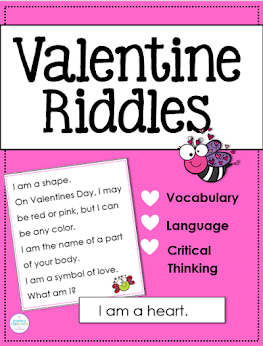


I hope this gives you some ideas to get started with!  Enjoy your free Valentines Day riddle set!


Click the image to see more Valentines Day resources!


Tuesday, June 9, 2020

Learning About Plants with Crosscurricular Teaching ... and Riddles!!

Are plants part of your science curriculum in kindergarten, first grade, and second grade? Are you having trouble getting all of your students to mastery, given the limited amount of time available to teach science? Here's something that might help you!


The Next Generation Science Standards call for students to describe patterns of what living things need to survive, understand how plant parts contribute to their survival, and observe plant needs, life cycles, and diversity.  Even with the language simplified as much as I did there, that's a whole lot of content!

Fortunately, most primary grade students are super interested in science. With interest so high, many of your students will bring their prior knowledge to your lessons, and of course those connections are going to help secure all that new vocabulary and information.

But what about those kids who don't have the background, or who aren't as interested? What do you do to make the path to mastery easier for them?

Have you tried riddles?  Kids love solving riddles, and I'm a big fan of using them in teaching.
I have riddles for everything from the ocean to animals, from sight words to digraphs. And math? More math riddles than I can count! Riddles get kids thinking, and help them make the kinds of connections that make new information stick!  Plus, every riddle that you solve together is another opportunity to model identifying key details, making inferences, and drawing conclusions. That's a whole lot of learning wrapped up in a package of fun!

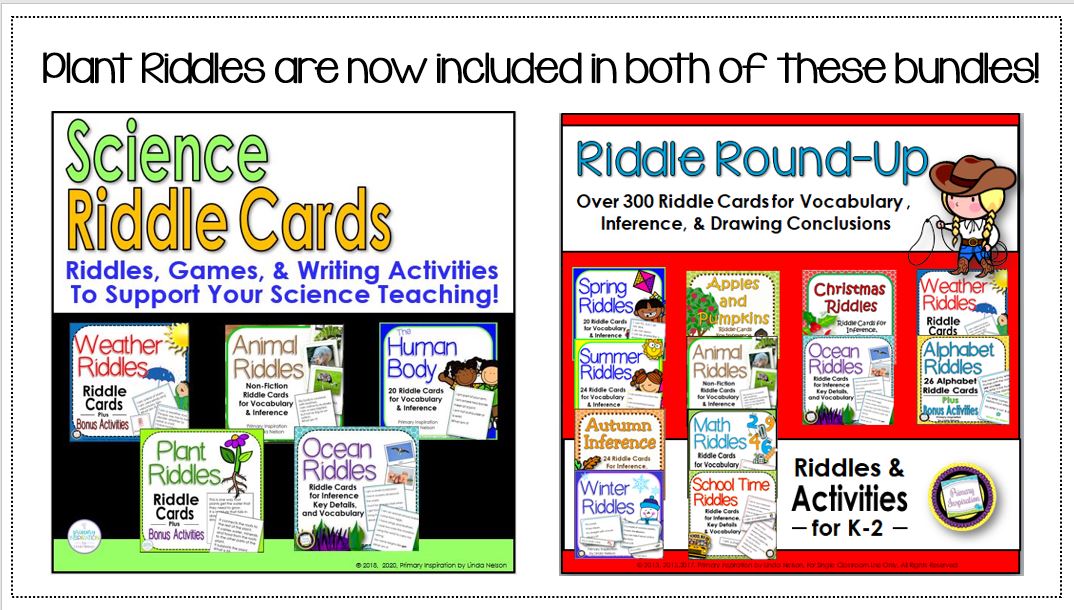
I just finished up a set of 20 plant riddles with answers like stem, leaf, seedling, germination, cactus, greenhouse, roots, tree, shovel, sun, soil, and nine more. It also includes a small group bingo game, a riddle writing activity, and a whole class graphing activity. I love incorporating cross-curricular activities in my science riddle sets. The more times your students see and hear these words, the more quickly they'll conquer them! Besides, who doesn't want to cover multiple standards withone activity?!?


Would you like to try a free sample from the Plant Riddles set?


Your sample includes three vocabulary matching boards with 20 plants vocabulary word cards on each board. Here are some ideas for using them.

* Cut a board apart and match the cards to another board that hasn't been cut. You can adjust this according to your students' needs: words to pictures, words to pictures / words, pictures to picture / words, etc.

* Cut all three boards apart into sets of 20 cards.  Have students find all the matching sets of three cards.

* Put the word cards or the picture / word cards in your writing center to encourage writing about science.

*  Use the cards in a literacy center for alphabetizing or syllable sorts.

*  Use on a tabletop pocket chart for categorizing and other activities.

Click to download your free copy!

Happy Teaching!

p.s.  If you already own either the Science Riddle Cards Bundle or Riddle Round-Up, please download them again ... the Plant Riddles resource is now included, and is yours at no extra charge, of course!


Saturday, November 5, 2016

Keep Learning Fun with Riddles!

Hello, Teaching Friends!
If you want to keep the fun in teaching and learning, try using RIDDLES!


I'm a big fan of making learning fun, because when kids are having fun, they want...

more,
more,
MORE!

... and what teacher would ever argue with a request for more learning?  When your students are having fun while they learn { I'm talking about the ... ahem.. "controlled" variety of fun, not the Halloween-on-a-Monday or running-around-screaming kinds of fun, noisy is fine, but no thank you to craziness ;) }, their brains are actively engaged and they're learning more.  
Besides, when they're having fun, I'll bet that you probably are, too!


1.   They encourage the development of extended attention. You've got to keep listening to get all the clues!


2.   Riddles help develop your students' listening skills, like attention to detail and focusing on the speaker. What a great social skill to have - listen all the way to the end of what your friend is saying,


3.   They are a superb way to teach using key details, making inferences, and drawing conclusions, critical skills no matter how you label them, and whether you're a Common Core district or not!


4.   Riddles encourage the use of mental images, a vital comprehension skill. Try solving a riddle without building some kind of mental image or even a graphic organizer in your mind, and changing it as new clues are added!  We do this as adults without thinking about it, but solving riddles together is one great way to model for your students the act and the language of how to develop and use mental images.


5.   Vocabulary! Our little learners are flooded with Tier 2 and Tier 3 vocabulary in November.  Once the words have been taught and your kiddos have had a variety of experiences to help them sink in, use riddles as a great review tool.


6.  Solving riddles encourages the use of connections, a comprehension skill we all try so hard to develop in our students.  Connecting the clues with schema and prior knowledge is a skill that takes intentional practice, and lots of it!  As you talk through the thinking process with your little learners, those skills will grow! When you're working together to solve a riddle, it's a great time to ask the questions, "What's your schema? How can what you already know help you figure this out?"


7.   Riddles are incredibly engaging! Everyone wants to play along, everyone wants to guess, and to make a reasonable guess, you've got to ...LISTEN and THINK! 


1.   Riddles are great as a quick supplement to your calendar time. A riddle can be solved in under a minute - that's a lot of learning value for just a tiny snippet of time!


2.   Use as a daily whole group activity when teaching social studies (or math, science,... whatever is relevant to the topic. They are a great way to get everyone quiet and focused!


3.  Use a riddle card on your smartboard to develop reading skills like those listed above. Call on students to identify and mark on the screen key words that helped them arrive at the solution.


4.  Listen without looking.  Can your students solve the riddles without seeing the words?  That's a whole different skill set than #3!


5.  Here's a cool idea that I recently received in a customer comment - use riddle cards for a quick and easy bulletin board display! A principal I once worked for required all hallway bulletin boards to be instructional and interactive. It was a bit challenging to create these at first, but once we all got into the swing of it - wow! You could always stop for a quick learning tidbit whenever you were walking your class anywhere in the school!


6.  Put a set of riddle cards in your sub tub, teamed with a themed read-aloud and a writing activity. {Most of the riddle sets in my TpT store include a template for your students to write their own riddles.} 


7.  They're a quick and engaging literacy center activity.  You might choose to have your students just number a paper and write the answers to the riddles. Or you could shake it up a bit by turning a set of riddle cards into a Read the Room activity.  Speaking of "shake it up", how about putting the answers on little cardstock scraps and sticking them into a shake-a-bottle?


8.  A riddle card on your smartboard is a no-prep Do Now when your students arrive in the morning, or come back to the classroom after recess.


9.  Early finishers love solving riddles. Print, cut, laminate, and put on a ring - a great alternative to extra worksheets!


Here are two free sets for autumn! The first has 8 riddle cards for words that you are teaching throughout autumn...


... and the second free set consists of eight cards specifically for Thanksgiving.  This set also includes a cut-and-glue activity, and is a part of a Thanksgiving Literacy resource that you can find at my TpT store.


If you're as sold as I am on using riddles in the classroom, I'd love it if you'd click to see the Riddles category at my store, where you'll find loads of riddle sets for seasons, science, math, sight words, and more.

Happy Teaching!


Tuesday, April 14, 2015

120 Third Grade Math Riddles - Free Sample!

Hi, Teaching Friends!

If you're a regular visitor here, you know how much I love using riddles in teaching. In addition to their ability to hold kids' attention and keep them begging for more (and who doesn't want to hear the words, "More math! More math!" ???), riddles are a great way to...

* review vocabulary
* model identifying key details
* model inferring and drawing conclusions
* refine listening skills
* encourage critical thinking skills

So, in addition to being lots of fun, these fun math riddles are a great match for your standards, too!


Today's freebie is designed for use in third grade, but would also be great for math coaches and tutors. It's a set of twelve riddle cards for third grade math skills. Take a peek!


Click here or on the image above to get your free sample set!


The complete set includes a riddle for every number from one to 120, along with an answer key to make this set perfect for independent use in math centers. If you'd like the complete set, which also comes with a solve-and-color activity, printable number grid game, and suggestions for use, click here or on the picture below to see it at my TPT store.


Happy Teaching!


Friday, March 20, 2015

Round Up The Vocabulary Riddles!

Happy Almost-Officially-Spring, even though another snowfall is predicted for our part of NJ today! Oh, well, even a little snow can't keep the optimistic crocuses from popping their heads up.


Image from Pixabay ... but my own sweet crocuses should be blooming by next week!


I'm so pleased to announce that I've finally completed the update on my Riddle Round-Up Bundle!


This bundle is now up to more than 300 themed and seasonal riddles, games for the same vocabulary, and writing templates for your students to create their own riddles.


Why use riddles?

* Riddles are a painless way to grow vocabulary (no worksheets!)

* Riddles are an effective way to model identifying key details, making inferences, and drawing conclusions.

* Riddles get your students making connections and building deeper understanding.

* Riddles are engaging, and they're FUN! Kids will beg to solve them again and again (more reading!!), and will further their learning by using the center games and riddle writing activitieis.

*  The riddle cards and activities in this set will provide you with so many activities for your centers ... literacy centers, pocket chart centers, science centers, ...


Here's a riddle from the spring set, which includes words like kite, puddle, umbrella, April Fool's Day, robin, and 15 more.  You can also get this set in Spanish or in a bundle that includes both English and Spanish spring riddles.


Here's an example from the summer riddles.


{{These two sets are also available in a Four Seasons mini-bundle here.}}

You can see other riddle sets by clicking here.

If you already own Riddle Round-Up, be sure to get your free update!

If you'd like a closer look at the bundle, click here or on the picture below.


Happy Teaching!


Thursday, November 13, 2014

Math Vocabulary Riddles - A Freebie!

Here's a way to combine teaching inference with your math instruction - math vocabulary riddles! 

You probably know how much I enjoy creating riddle sets, so here's the latest one. It's a brand new resource that I just posted at my TpT store, Math Vocabulary Riddles.


The set includes twenty riddle task cards for terms like calendar, addition, ruler, square, ten frame, and penny. It also includes a four-in-a-row game using the same terms, great for math centers, early finishers, and math tubs.


If you've been looking for ways to build connections across the curriculum, try writing math vocabulary riddles with your students. The template in this resource will make it easy for you to teach your class how to write their own!


What can you do with the riddles your students write?

* Bind them together into a class book
* Use your riddles to create a quick and fun bulletin board display.
* Practice speaking and listening skills by planning a performance. Throw in a microphone for fun and to encourage fluency. have your troupe of performers put on a show for your class... or go on tour to other classrooms!


Would you like to try a free sample?  Here's a set of eight riddles that you can download from Google Drive. Just click here!


Happy Teaching!


Tuesday, October 28, 2014

Pirate Riddles with Two-Digit Numbers - Aye, Me Mateys!

Hi, Teaching Friends!


I love creating resources that sneak a lot of learning into a bit of fun. Games, riddles, puzzles, ... learning in a fun package!

So, here's a taste of some more of that kind of learning. These riddles for two-digit numbers are elimination puzzles. Your students will read 4 or 5 clues and compare the answers to a set of nine numbers, crossing out the relevant numbers. The number that's left at the end is the Pirate's Secret Treasure Number.


Here are a few examples of the kinds of math riddles your students will be solving.

"It's not greater than 7+19."

"It's not an odd number."

"It's not 41+ 22 or 51 + 32."

"It's not half of 100."

"It's not a number that you can make using only nickels."

"It's not a number with two different digits."

Lots of math skills, critical thinking, and variation in levels of difficulty.  There are 24 cards in all, plus a student response page with answer key. 

Use them as task cards for math centers, for early finishers, or as bell ringers. These cards are great to use for a skills rotation (Scoot!), with your students moving around the classroom either alone or with a partner, solving as they go. Or just put one of the riddles up on your doc camera when you have a few minutes - a super sponge activity, packed with lots of Common Core content practice!


Click here to see this set at my Teachers Pay Teachers store!


Would you like to try a sample? Just click on this cover and enjoy!


https://drive.google.com/file/d/0B8LaCTimmHFZOVAzV29qemlwMUk/view?usp=sharing


Thanks for stopping by!
Happy Teaching!


Saturday, September 20, 2014

Apple Blog Hop ~ Rehearsing Learning with Puppets


Hi, Teaching Friends!

It's apple season again, and time for another great blog hop!


Do you love reading aloud to your class? I think it's one of the coziest, calmest, and happiest times in the day. It's also a time that's chock full of teaching opportunities, making it all the more important to choose read aloud books carefully and pre-read them thoroughly. (I could share a cautionary tale about reading Tomie DePaola's  Bill and Pete to a class without pre-reading ... but that's another story for another day...)

Here's a book that I've found to be a great teaching tool for this time of year, Amy and Richard Hutchings' Picking Apples and Pumpkins.


There are a number of other good books with similar titles out there, but what makes this one my favorite is the fact that it's illustrated with photos. I think that really brings the book to life and encourages children to make comprehension-building connections with their own lives. I'm also partial to this book because it was photographed at Battleview Orchards, which is only about 45 minutes away from where I live here in New Jersey. We've been apple and pumpkin picking there with our own children!

After you read, you might want to try comparing apples and pumpkins, using one of these great ideas from Pinterest. These fruits are a natural for using Venn diagrams!


Here's a great one from Simply Second Grade ...


...and another variation is this double bubble thinking map from My First Grade Backpack. This one will also leave you with a useful anchor chart for your fall writing center.


One way that I've enjoyed extending the value of read alouds is to make simple puppets and use them to rehearse the language and concepts of the book. Puppets are fun, engaging, and often just what's needed to build confidence and speaking skills in your more introverted students.

I like to keep the puppet-making simple, like these quick-and-easy construction paper and popsicle stick ones. But don't stop there ... add in a literacy component!


Let's have a show! Using dialogue is a great way to cement learning from a read aloud and to master new content area vocabulary. In kindergarten and first grade, it could be as simple as partnering students and having them act out little conversations, using  the new vocabulary from Picking Apples and Pumpkins.


After a minute or two of conversation, switch partners for a new talk and new practice. Quick-paced, fun, and effective practice of new vocab and concepts!


With more advanced writers, try having partners write the dialogue. The anchor charts above would be good graphic organizers for this. Keep a copy of the book you read as well as other relevant books handy for inspiration and reference, and remember to leave time for performances, too!


Here's another way for your students to practice their learning about apples and pumpkins.  With this brand new set of 20 riddle cards and a four-in-a-row game, your students will practice inference and build vocabulary like pulp, core, vine, harvest, and 16 more. Check it out here at Teachers Pay Teachers or here at Teachers Notebook.


Would you like to win a copy of this riddle set? I'm giving away three during this blog hop!

a Rafflecopter giveaway


Time to get hopping to Kooky Kinders for more great apple fun! Just click on the cute owls and enjoy the rest of the blog hop!

                                                           http://kookykinders.blogspot.com/2014/09/an-apple-for-teacher-blog-hop.html                


Happy Teaching!


Wednesday, August 13, 2014

Place Value Riddles for Three Digit Numbers ~ Free Sample!

Hi, Teaching Friends!

I'd like to introduce you to my latest math resource, which has taken a totally ridiculous amount of time to complete, as in months and months! The reason for that is that it has changed focus and direction more times than I can count, and I'm not even going to try to explain that. Here's what I finally settled on!


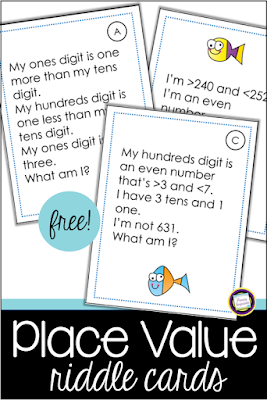
While these are called place value riddles, and there's mention of hundreds, tens, and ones in each of the fifty riddles, they are really more about operations, mental math, and reasoning. These two cards will give you a good idea of the types of clues and the difficulty range in this set.


Creating these riddles was fun, and using the Fun Fish graphics from Mel at Graphics From the Pond made it even more so! Are they the cutest or what?

 Click here or on this picture to see more details at my TpT store!


Would you like to try a few samples from the set? Click here or on the picture below this cover and enjoy!


Thanks for stopping by! Happy Teaching!


Related Posts Plugin for WordPress, Blogger...