Showing posts with label math center. Show all posts

Saturday, June 21, 2025

Sums of Ten - Task Card Freebies for the Win!

Do you use task cards? What an amazing classroom tool they are!

✅  They're a fun & engaging way to for your students to practice skills (waaay more fun than worksheets!)

✅  Task cards are easy to store and keep organized (tip: try using photo boxes, from the scrapbooking aisle in craft stores!)

✅  They're available for so many skills ... math, reading, science, even social studies!

✅  Task cards are easy prep - just print and cut apart. Even better, if you laminate them, you'll only have to prepare them once and you'll use them for years.


Want to save this post for later? Just click the Pinterest button!


If you're not yet taking advantage of this versatile tool, I'd definitely recommend downloading the great free guide from Rachel Lynette, who's undisputedly The Queen of Task Cards!  You'll find ideas for using your task cards, storing them, and many other helpful tips, too. It's all in this free ebook at Rachel's TPT store. Do not miss out on this one!

Whether you're new to task cards or you've already got a huge collection, I hope you'll give this new set a try in your classroom. 

These cards are a fun autumn-themed way to get your students up to speed on sums of ten. It includes twenty bright and engaging cards that use ten frames for visual support.

You can use this free collection in a math center as is, or you might try displaying them around your classroom for a Read the Room for Math activity. The cards are also good for a fun game of Scoot! Your download also includes an answer key and a recording sheet that you can use with any of these options for play!

Click here to download your copy. Enjoy!


Click to see more resources for sums of ten...


Happy Teaching!


Sunday, October 20, 2019

Mix Math with Art for Integrated Fall Curriculum

If you could do a project with your class that would mix math and art, and you'd end up with a cute fall classroom display plus a set of math center games, would you give it a try? Well, let's find out more about this integrated curriculum project!


Want to save this post? Just click the red Pinterest button!


I love using integrated curriculum, and creating it, too!  Cross-curricular resources are a great way to reach more students, since they address multiple interests and learning strengths. Integrated curriculum also offers great opportunities for review and overlearning, which many students need to be able to retain concepts and vocabulary and to apply them, too.  Sometimes, changing the context of the instruction makes all the difference in student engagement and success!

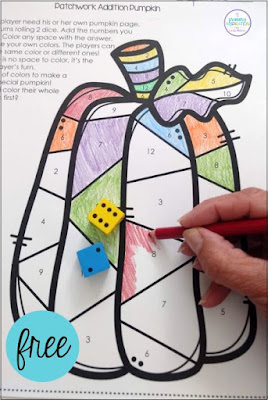
This math and art resource has your students rolling two dice and adding the numbers and then choosing any space with that number to color. They can do this independently, or play with one or two other students, each with their own pumpkin page.

But if you take it a step further - here comes the art integration!


How about demonstrating how to use colored pencils to make lighter and darker tones of the same color, and then setting your students to work on these pumpkins to test their skills?


Pull out a color wheel and discuss complementary colors, the opposites on the wheel. Challenge your students to choose any pair of complementary colors to complete their pumpkin. Here's one example using oranges and blues, but there are so many interesting variations of complementary pairs to try!


Once these works of art are complete, how will you use them in your classroom?

* Cut the edges and directions away and hang them on classroom windows for a pretty display that you can keep up all through October and November. The sun really lights them up, as you can see here on these photos of the free subtraction version of this project.

* No windows? (I've taught in a classroom like that... ugh.)  Back your pumpkins on a piece of black construction paper for a great wall display!

* Here's a fun and easy way to turn your pumpkins into autumn math center games that your students will love to play again and again.  Step One: When your students are rolling, adding, and coloring, have them color lightly (so the numbers will show through) and tell them that you have something special to do with the neatest ones. (usually a pretty good motivator!).
 
   Step Two: Cut the pumpkins around their outline, like you would for the displays above, and laminate them. Now each one is a board game! Students play by rolling, adding, and covering the sum on their board. Some fall mini-erasers from your stash will be great for this, or just use erasable markers. Two students can play by sharing one board or by each using a different board. Student motivation is HIGH when they see that their own work is being put to such a good use!  {Pssst! You can do this with almost any color-by-code activity page!}


Are you ready for your own copy of Patchwork Pumpkin Addition? Just click here to download and enjoy!

*****

Here's more autumn math fun for your students!


Happy Teaching!


Saturday, March 3, 2018

Beat Spring Fever with a Spring Math Game Freebie!

Hi, Teaching Friends!

Has Spring Fever struck in your classroom yet? We all know that it takes just one day of nice weather to get it going ... a sunny day of warm winds blowing on the playground ...


And after Spring Break? Well, that's another thing that we all know:  you're going to need every trick you've got to keep your students' attention!

What's the A#1 way to keep your students engaged in learning, even when Spring Fever has taken hold? Keep sprinkling the learning with fun!

And what's the easiest way to keep things fun AND keep the learning moving forward, too?  My vote goes to GAMES!!  Games are a wonderful learning tool all year, but in spring, they can be a sanity-saver!

*  When your students are playing games, chances are great that they're going to stay focused longer, and that means they'll be getting more practice, no matter what skill the games are designed to reinforce.

*  Playing games will also continue to promote the social skills that you've been teaching all year, like taking turns, using kind and respectful language, being a good loser ... and a gracious winner, too!

*  When your students are playing games and you've established rules that will help them be independent, you'll be able to carve out some time for one-on-one end of year tasks, like reviewing portfolios and testing.

Second grade teachers, here's my latest set of math games for your classroom, 15 spring games for addition, subtraction, and place value. 


All of the games are just one page, truly easy-prep! All of the games come in both color and black & white - nice for sending home for extra practice, and a great homework alternative! Plus, no cards to print means no cards to lose! These games are a super easy way to fill your math centers and math rotations for spring.

The games in this set were designed to build your students' number sense. Many of them also promote strategic thinking, like making the choice whether to add or subtract on a turn, or where to place a line to complete a square, or whether it's a better strategy to play your move or block your opponent.

Would you like to try a free game from this set?

Here's "Every Birdie's Adding",  loaded with opportunities for strategic thinking! Click to download your copy!


Happy Teaching!


Sunday, March 15, 2015

Pets Bring Extra Love to Learning!

Hi, Teaching Friends!


Do you have a pet in your classroom? Well, then you already know how those extra expenses add up!
There are so many wonderful things that our students can learn by caring for a classroom pet, but food, hygiene, and even the occasional vet's visit can sure take a toll on the budget!

Do you know that there's money available to help?  I'd like to tell you about Pets in the Classroom, a non-profit, charitable, public foundation. The foundation is funded by donations from individuals, pet industry companies, industry associations, corporate sponsors, and other foundations. Although I don't have personal experience with this, the grant process seems to be very straightforward: one grant per teacher per year, and you find out if you're approved in just 3-4 weeks!

Seven kinds of grants are offered:


The site also has free downloadable care sheets for animals ranging from dwarf gerbils to leopard geckos. They're written for 4th or 5th grade, but we all know that a piece of highly motivating material will often be attacked and mastered by many students who technically aren't actually at that reading level yet. Just display the print-outs near where your classroom pet resides for some instant non-fiction text practice!


If you need to convince your administrator that having a pet is a beneficial and ... dare I say it ... even a Common Core-justifiable practice, Pets in the Classroom has this print-out for you.


There's even a link at the site for a quick and easy way to tell your friends about this program ... click here to "tell a teacher"!

If your students (or YOU!) are kind of crazy for cats and dogs, here are a few resources you'll love!


It's time to share the puppy love with a freebie! This set includes a blank game board for you to use with your own flash cards, plus the two completed ones you see here, ready for your kinders and firsties to use! Just click here or on any of the images below to get your freebie!


Have fun loving your classroom pets! 


Happy Teaching!


Saturday, November 8, 2014

0-120 Place Value Decks from The Math Maniac

Hi, Teaching Friends!


I'm so excited today to have the opportunity to share with you a wonderful resource and some activities from Tara, The Math Maniac!


http://www.teacherspayteachers.com/Product/Numbers-to-120-place-value-decks-800015


In so many ways, the cards in this resource remind me of a big box of Legos.


* They're all the same, yet all different
* You pull out something different every time you reach in.
* You can use them in a different way every time you use them.
* The deeper you dig, the more ways you discover to use them.


The Math Maniac has worked for nine years as an elementary math specialist. Tara's approach is constructivist, with an emphasis on helping her students make connections between things they have learned. This resource is a wonderful tool to do just that!


She calls this set "the hardest working thing I have ever made", and I would agree that this is definitely an extremely versatile set. Like many of her resources, at first glance it's just a very simple
no-frills set.  After you print and cut the decks, there is little to no teacher prep required for the activities. 


Here's the Hidden Value to this resource: Tara has added in photos and some of the most thorough suggestions for implementation I've ever seen!


"Place Value Decks: Numbers to 120" consists of three card sets, all from one through 120: place value representations with corresponding numeral, place value representations without numerals, and numerals.


The product description and suggestions list it as suitable for K-3, and I put that to the test working with two of my grandchildren, ages 5 and 7.


Mr.E, age five, hasn't started kindergarten yet, but has a good grasp of early math concepts. He counts to 100, matches one-to-one in counting, counts by tens, and does simple addition and subtraction word problems in his head. Here's how we used the cards together.


We started with some sequencing of the numeral cards, emphasizing the teen numbers, and then doing a bit of review with pulling through the decades. After he arranged the cards in order, we practiced some counting up and counting back, with E pointing to the cards as he counted.


Then out came the Legos! We started building models for some of the numbers and then compared pairs of the Lego sticks, using math comparative words like longer/shorter, more/less, and greater number/lesser number.


We made models for 12 and 21, because the names of teen pairs (12/21, 13/31, etc.) are still not secure skills for him. Using the model and then bringing in the numeral cards to reinforce was helpful.


With the teen numbers, we talked about how easy it is to miscount when you use very long sticks of Legos, which made a simple segue into making sticks of ten blocks and then counting on by ones. We practiced this with several numbers in the teens and twenties. Since he's already able to count by tens, transitioning to counting on by ones was simple for him. Hopefully that will also be the case when we apply this to counting dimes and pennies some day soon! :)


Then we brought out the place value representation cards. Although E and I didn't go beyond 30, it was great to have all of the cards through 120 available, to make it easy to follow his lead and respond with both support and challenges as needed.


When E was very comfortable with going back and forth between the numerals, Lego models for numbers, and Base Ten cards, it was time for a game!


I put out a selection of some of the Base Ten cards between one and thirty. E named the number for each card and then lined them up in rows from least to greatest.  Then I brought out this extremely cool thirty-faced die! {What's the correct mathematical term for that, Elementary Math Maniac? ;) Whatever it is, every classroom needs a selection of great dice like this one!}  Edit: Tara tells me that it's a triacontahedron. It's more commonly known as a 30-hedron, but personally I think the long name is much cooler. Wouldn't some of your little ones enjoy tossing around a word like that? It's almost as good as Tyrannosaurus Rex!


We took turns rolling the die and checking the cards to see if the number we rolled was there. If it was, the player took the card. If not, the other player rolled. The first to get five cards won. So simple, but such good practice, and fun!


I love these cards - they make these spontaneous truly no-prep games a breeze!


This resource would be a wonderful choice for homeschoolers and math specialists because of the range of numbers, the many ways to use them, and the ease of differentiation for levels.

There are two more things that I consider to be major pluses for this card set:

1. There's a complete listing of the standards addressed - the whole standard, not just the number.
2. There are links to related blog posts for you to see the cards in use.

Click here to see 0-120 Place Value Decks at Tara's store. For second and third grade, try the Numbers to 1000 set!


Check out The Math Maniac's blog and Facebook page. Tara just completed a great book study, Chris Biffle's Whole Brain Teaching for Challenging Kids, and is always offering up some new and interesting insights on teaching math K-5.


Thanks so much for sharing this set with me, Tara!
Look for Part 2 of this post next week to see how I used the same set with E's big sister, age 7.


Happy Teaching!


Monday, May 12, 2014

FREEBIE! Adding and Subtracting Multiples of Ten

Good Monday Morning, Teaching Friends!

Are you practicing adding and subtracting multiples of ten? Being able to do that quickly is a powerful tool for mental math, so here's a freebie for a bit more practice! 

Use as a follow-up to your lesson, for a fun homework assignment, a morning Do Now, or just pop it into a math center with a hundred chart for some bonus practice on this early place value skill!

Thank you to KPM Doodles for the sweet Zoofari animals.

Click here or on the picture to download your copy.


https://docs.google.com/file/d/0B8LaCTimmHFZcmxGN2UteVlKOTg/edit


Happy Teaching!


Sunday, November 17, 2013

Sums of Ten Thanksgiving Freebie

Hi, Teaching Friends!

Are you working on sums of ten with your first graders? Don't get discouraged! For some little learners, you'll need to try lots of different ways to make all those combinations of ten STICK!

I remember one little darling saying to me, "Wait- you mean we have to REMEMBER these???" Yes, sweetie, you do. Although, I really couldn't fault her, since I have a very clear memory of my own first trigonometry test, where I was in total disbelief that there wasn't some kind of reference chart, that I was actually supposed to memorize all those... things. (You can see right there how I met up with the first test that I ever failed. Hittin' the wall is no fun, people.)

So, we need to teach those combinations of ten lots of different ways, and convince our students of just how important those sums of ten are... because we have lots of different kinds of learners!

I love the idea of Rainbow Tens that's all over Pinterest, where you write the numerals from zero to 10 across the bottom of the page and make a different color arch to link each set of addend partners... zero links to ten, one links to nine, etc.  Nice visual!! That makes a great anchor chart to keep posted and referring to in your classroom.

I've also used Friends of Ten, with headbands or wristbands for each student, each with a numeral 0-10 on it. Randomly put clusters of students around the room and on the word "Ten!", students quickly move to find and hold hands with a friend that makes ten.  They love this game (most likely because they're up and moving around!), and it's another way to make the point that you need to know all of those facts, but the totals of ten are the Super Important ones!

Since we're coming up on Thanksgiving, here's a free sums of ten board game for partners with a turkey theme, Turkey Time Tens. Your students will roll a die, determine what number needs to be added to it to make ten, and cover that number on the board. What?!? That's missing addends practice, too!

The download includes both color and grayscale versions. It's a simple game, but hopefully a helpful one for you and your students! Just click here or on the picture to get your download. Enjoy!


Happy Teaching!


Monday, October 28, 2013

Sums of Five and Ten - Dollar Deal!

Hello, Teaching Friends!

EVERY young math learner can benefit from some extra practice with sums of ten. Whether you call them sums, combinations, or even friends of ten, your students need to know these pairs of numbers well as they move toward toward using ten as a benchmark number when adding within 20, and even beyond.

This is a foundational skill. Here's a fun way to build the strength and fluency, and in a fun way!


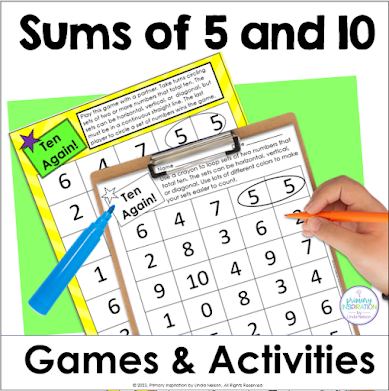
This composing and decomposing set has built-in variety! At each level (sums of five, sums of ten), you'll get two activities: a b/w printable for independent use and a colorful game board for two players. Laminate the game or insert into a plastic sleeve for long term use.


This is an easy prep and engaging math activity for you and your kiddos. It's great for math centers (with a handful of manipulatives to support your earliest learners), for independent work, or for early finishers.  

Number searches like this are very appealing to students and a great way to practice both basic facts and more complex combinations.  They are challenging and engaging enough that you can feel comfortable having these set up as an activity for your early finishers, or even sending the blackline version as a fun homework alternative.


Want to learn more about how this early exposure to composing and decomposing transfers to other math areas across the grades? Here's a great post by Donna at Math Coach's Corner.


If you'd like your students to have even more practice with composing and decomposing numbers, this set of number searches at my TpT store includes searches for the sums of 5 through 20. It has both blackline printables  and partner games like Thinking About Thirteen, pictured below.

How many more combinations for 13 can you find in the picture? I don't know about you, but a challenge like that tends to keep me compulsively searching. aka Sneaky Learning Disguised as Fun!


Here's the complete collection.


Click here or on the pictures to see it at my store.


Happy Teaching!


Thursday, October 10, 2013

Addition with the Firefighters - a Freebie for You!

Hi, Teaching Friends!

Are you ready for Fire Prevention Month?

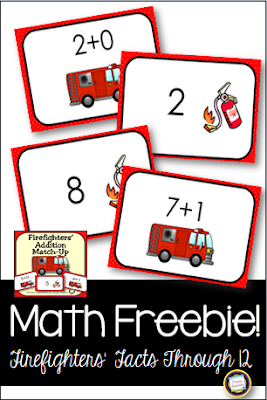
Carry your fire prevention teaching over into math with this mini-math freebie.  Your students will enjoy matching fire engines with fire extinguishers while they practice finding the sums for +0 and +1 number models.  Perfect for math centers and math tubs! 

Click here to download your freebie!


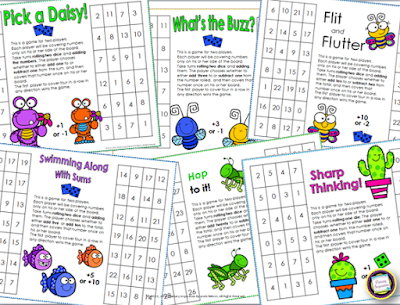
As your first graders begin to learn more addition strategies, here's a set of six games that will give them new ways to practice!


Click here or on the cover below to see Addition and Subtraction Mental Math Strategy Games.


Happy Teaching!


Saturday, February 16, 2013

The Leprechauns Took the Numbers - Freebie!

Hi, Teaching Friends!

Are you getting ready for lots of St. Patrick's Day fun with your little learners? You know what I mean... hidden gold coins, flipped over chairs, the kind of stuff that leprechauns specialize in!

Here's a math game that combines a bit of the fun of leprechaun mischief with practicing the sequence of numbers from 11 to 20. There are 3 sets of write-on-wipe-off cards: "What comes next?", "What comes between?" and "What comes before?"  You can use the sets separately to focus on the particular needs of a student, or mix them together to give your most capable students a challenge.


Happy Teaching!


Tuesday, March 6, 2012

St. Patrick's Day Math Freebie for the Hundred Chart!

Hi, Teaching Friends!

Today I want to tell you about this free set of  Lucky Numbers Hundred Chart Games.  These simple games are MAGIC for math review on the hundred chart! Fun for St. Patrick's Day, especially when you use fun little erasers like rainbows and pots of gold as game board markers. 🍀 Use them for the 100th Day of School, too!

Hundred chart and 120 chart games are a great way to work on number sequence, counting and matching one-to-one, counting on, and sometimes even a bit of addition, subtraction, and place value.

These Lucky Numbers hundred chart games are low prep and super simple to play, but my first graders have loved them over the years!  The games all use a hundred chart as the game board (print the St. Patrick's one that's in this pack, or just use your own).  Players roll two dice, add, and move ahead that many spaces.


So, what's new about that?? Well, read on! 


What makes these games extra fun is the **Lucky Numbers** twist.  Each set of players has a task card with a different set of lucky numbers. When a player's turn lands him on one of those numbers, he  moves ahead ten spaces, which to a first grader is almost as good as winning an extra recess!


Seriously, kids think they're playing a new game whenever they get a new set of numbers, so they want to play again, and again, and ...   😊 Meanwhile, there's lots of addition practice as well as some bonus practice with moving ahead ten on the hundred chart.


Click here or on the picture to get your free set!


Find more 120 chart games like the ones shown here when you visit my TPT store!


Happy Teaching!
                                                                     
Related Posts Plugin for WordPress, Blogger...