Showing posts with label science. Show all posts

Thursday, September 18, 2025

Save Time for Teaching Science!

When super busy days squeeze something out of the daily schedule in our primary grade classrooms,
it's very often science or social studies that fall by the wayside. That's sad, because we know how important both science and social studies are and also how much many of our students love them. 


But the reality is that literacy and math are at the top of the teaching (and testing!) list and we all know it.


So, what can we do about it? Well, one idea that I'm sure we all try to do is to choose our readalouds with an eye to the content area topics we're teaching.  Solid readalouds packed with the vocabulary of your science topic give your students' repeated exposure to content area vocabulary, and also address literacy standards for non-fiction. A great book can also be the springboard for some non-fiction writing, either whole class or in a writing center.


Integrating science into your math and literacy teaching (and vice versa!) is another idea for making the most of your teaching time. Integrating curriculum is also a surefire way to improve vocabulary understanding and retention and, in simple terms, to help the learning stick!


Here's an easy way to help you put more science back into your day. 


This set of 45 graphing and writing experiences to address eight of the most popular first grade science topics (in some curriculums, the landforms and bodies of water topics will bridge over into social studies).

Here's what's included! 

► 7 independent graphing experiences, including two read-and-graph reading passages (answer keys included)

► 9 student surveys (students interview their classmates and then record the data)

► 7 class graphs in color, for teaching/modeling or for a class book.

► 22 writing activities to use along with the data collection experiences. Writing formats include ...


                    * Personal narrative

                    * Lists

                    * Labeling

                    * Completing graphic organizers

                    * Persuasive writing

                    * Non-fiction

                    * Descriptive writing

                    * Friendly letter


You'll be happy to see how much teaching time you'll save with these one-page easy prep resources!


Are you ready to try this free set of three plant activities from this graphing and writing collection? You'll find it when you download the preview! Click here to get yours!


Friday, April 14, 2023

Learning About Animals with Read-Aloud Books

Books about animals are universally appealing. So many of our students seem to have an unquenchable thirst to learn more about every kind of animal!  What better way to learn more about animals than through great read aloud books!

Using good read alouds was always a big part of my science teaching. These non-fiction books are such a great way to introduce or review concepts and vocabulary. And of course, a read aloud book is also a great way to kick off a writing project!

What makes a good non-fiction read-aloud for the primary grades? There are so many factors! As a start, I'd suggest taking these into account when making your book selections.


Typically, I'd be looking for books with photographs, particularly if you have students who haven't had the opportunity to visit a zoo or animal park.


That being said, some of my personal favorites among animal books are written and illustrated by the amazing Steve Jenkins. 


These books may not have photos, but they have awesome illustrations. I love that the size of the books is large enough and the illustrations are bold enough that even the kids at the back of your story circle can see them easily!  Plus, these books definitely have that WOW factor that will keep your students engaged and begging for more!


Just pull out any one of Steve Jenkins' books and watch your students' eyes light up! (Don't you love it when your students start to recognize the books of a favorite author and even seek them out at the library?)


Have you read this Caldecott Honor Award Winner?  It's in the format of a guessing book. Students are shown a snout, ears, feet, etc. and then learn which animal the body part belongs to  and how the animal has unique ways of using that part.


Have you heard your students argue about which animal is faster, the cheetah or the falcon?  Kids love records - they'll be reading those Guinness Record books in just a few short years! Here's a Steve Jenkins book that will feed their curiosity about which animal is fastest, strongest, longest - the record holders of the animal world!


My favorite? Without a doubt, it's Actual Size! Your students will be amazed as the pages of this clever book unfold to display the actual size of a squid's eyeball or a gorilla's hand. You'll hear lots of oohs and aahs when you read this one... and they usually want to hear this book again and again!


As your students become animal experts, here are two resources you'll enjoy using!


This set of 24 riddle cards plus related activities is a fun way to reinforce learning about animal characteristics, habitats, and classes. Teaching with riddles is also a great way to model early reading comprehension strategies like identifying key details, inferring, and drawing conclusions!

                                                    
                                                 Click the Pinterest button to save for later!


If you're looking for a whole class activity, a game of I Have ... Who Has... is always a hit! The animal theme makes them a perfect fit for your animal studies. If the reading level is a bit tough for some of your young students, just assign "support partners" - a weaker reader with a stronger one!


Happy Teaching!


Tuesday, June 9, 2020

Learning About Plants with Crosscurricular Teaching ... and Riddles!!

Are plants part of your science curriculum in kindergarten, first grade, and second grade? Are you having trouble getting all of your students to mastery, given the limited amount of time available to teach science? Here's something that might help you!


The Next Generation Science Standards call for students to describe patterns of what living things need to survive, understand how plant parts contribute to their survival, and observe plant needs, life cycles, and diversity.  Even with the language simplified as much as I did there, that's a whole lot of content!

Fortunately, most primary grade students are super interested in science. With interest so high, many of your students will bring their prior knowledge to your lessons, and of course those connections are going to help secure all that new vocabulary and information.

But what about those kids who don't have the background, or who aren't as interested? What do you do to make the path to mastery easier for them?

Have you tried riddles?  Kids love solving riddles, and I'm a big fan of using them in teaching.
I have riddles for everything from the ocean to animals, from sight words to digraphs. And math? More math riddles than I can count! Riddles get kids thinking, and help them make the kinds of connections that make new information stick!  Plus, every riddle that you solve together is another opportunity to model identifying key details, making inferences, and drawing conclusions. That's a whole lot of learning wrapped up in a package of fun!

I just finished up a set of 20 plant riddles with answers like stem, leaf, seedling, germination, cactus, greenhouse, roots, tree, shovel, sun, soil, and nine more. It also includes a small group bingo game, a riddle writing activity, and a whole class graphing activity. I love incorporating cross-curricular activities in my science riddle sets. The more times your students see and hear these words, the more quickly they'll conquer them! Besides, who doesn't want to cover multiple standards withone activity?!?


Would you like to try a free sample from the Plant Riddles set?


Your sample includes three vocabulary matching boards with 20 plants vocabulary word cards on each board. Here are some ideas for using them.

* Cut a board apart and match the cards to another board that hasn't been cut. You can adjust this according to your students' needs: words to pictures, words to pictures / words, pictures to picture / words, etc.

* Cut all three boards apart into sets of 20 cards.  Have students find all the matching sets of three cards.

* Put the word cards or the picture / word cards in your writing center to encourage writing about science.

*  Use the cards in a literacy center for alphabetizing or syllable sorts.

*  Use on a tabletop pocket chart for categorizing and other activities.

Click to download your free copy!

Happy Teaching!

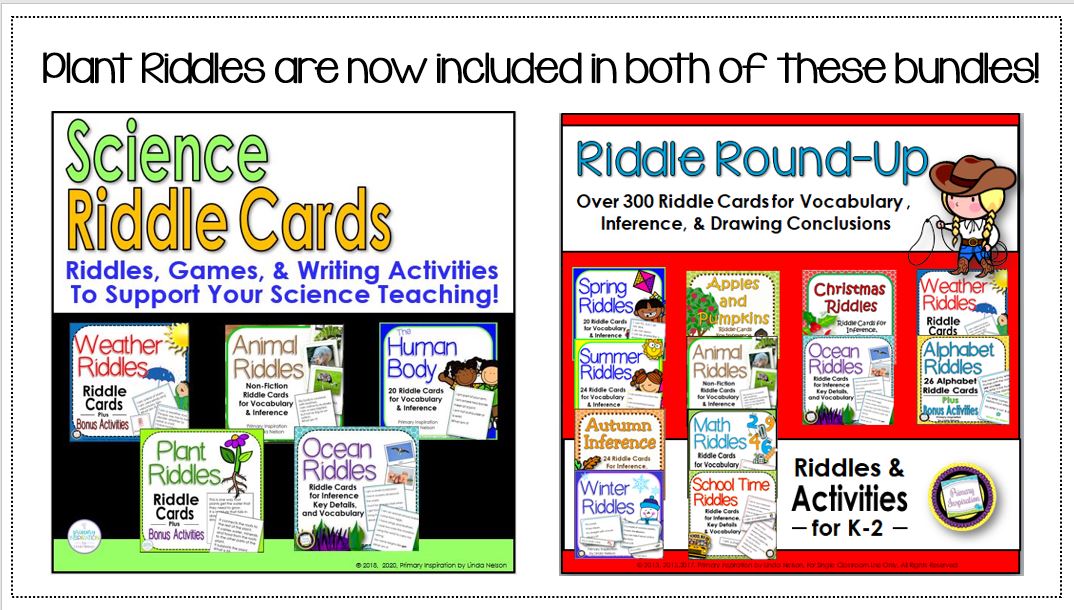
p.s.  If you already own either the Science Riddle Cards Bundle or Riddle Round-Up, please download them again ... the Plant Riddles resource is now included, and is yours at no extra charge, of course!


Friday, April 25, 2014

Spring into Science with a Weather Freebie!

Hi, Teaching Friends!


Is weather part of your science curriculum? Whether it is or whether it's not (sorry, couldn't resist the pun!), the weather is a very real part of our little learners' lives. They hear their parents talk about it every day and they see how it affects their own lives, from what they wear to whether recess will be indoors or outdoors. Even if weather is not an assigned unit of teaching for you, there's a lot of value for your students in teaching about weather and seasons.

Studying weather is a great way to observe and record change over time, which is a skill that applies to other areas of the curriculum. Think about literacy, where we teach our students how to observe changes in characters over the course of a book. How about history, where even our youngest learners will be learning about differences in how people used to live long ago and now? Observing and describing change is an important skill!

Weather and seasons are also a great way to demonstrate the reliability of patterns. Even though weather is not always completely predictable (sometimes hardly predictable at all, it seems!), the cycle of the seasons is a predictable, repeated pattern over time. Even after the kind of winter many of us just came through, spring always follows. The seasons are a pattern. So is the evaporation-condensation cycle. Patterns are a huge part of math, too ... skip counting, multiples, time around the clock, and so many patterns on the hundred chart! 

In reading and writing, the dependability of spelling patterns helps our students apply the onset/rime principle as they decode and spell. Amidst the unpredictability of our English spelling, it must be somewhat of a reassurance to struggling young readers that at least some words have usable patterns!

Story structures are another example of predictable patterns. Familiarity with the days in the week pattern of Brown Bear and the months of the year in Jesse Bear will make other books easier to read and understand. Readers will apply the cumulative pattern of a book like The Jacket I Wear in the Snow as they read similar books.

Even an informal study of weather is valuable as a tool to help us teach our students to build connections across the curriculum.

Here's a free set of weather vocabulary cards! Use them for vocabulary review or alphabetizing, or print two sets for matching and memory games. Or, leave the cards as a whole page and put it in your writing center to encourage writing stories, poems, and non-fiction pieces about the weather. Just click here or on the picture to download and enjoy.


https://drive.google.com/file/d/0B8LaCTimmHFZVW1HWGRkOHJ5Nm8/edit?usp=sharing


The word cards are part of my Weather Literacy unit, 15 Common Core aligned literacy activities to support your science teaching. Weather phrases for building fluency, fact and opinion sentence strips to sort, riddles for inference, an "I Have, Who Has.." game to reinforce vocabulary, syllable sort, making words, compare and contrast, nouns and adjectives, alphabetical order ... over 70 pages of activities for centers! Click to see it at my Teachers Pay Teachers store.


Happy Teaching!


Thursday, April 12, 2012

Celebrate Earth Day with the World's Best Composters - Earthworms!

Hi, Friends!

While digging in my garden today, I came across the World's Best Composters - earthworms, and LOTS of them!

'Though they might not be your favorite, there's sooo much learning to be had for your students from a hands-on experience with earthworms. WAIT- don't stop reading! Trust me on this one!


An earthworm has awesome connections to Earth Day - they live by reusing and recycling, all the while aerating the soil and providing us with awesome compost. If you're a gardener, you already know where the worms are. If you're not into digging, just check out the sidewalk on a rainy morning. And if you don't want your neighbors to think you're crazy for being out there in the rain picking up worms, just pay a neighborhood kid a few dollars to collect a bunch for you. Of course, he'll probably tell the other neighbors anyway, so there you go! Of course, you could also go to a bait shop, but that's not as much fun and your little guys won't be nearly as impressed as if you're a dig-it-yourselfer.


BTW, if you're thinking about germs, I haven't been able find any info at all that connects them to anything harmful. The Maoris even eat some kinds! (There I draw the line... and I don't tell the kids about that until we've released the worms into the garden!)  Do you seriously think your kids have never had their hands in the dirt? I guess if it really bothers you, then wear rubber gloves. Again, not as much fun.


I've usually transported the worms to school in a shallow disposable (ya think???) plastic container with plenty of slightly damp soil in it and a few small air holes poked in the lid. You'll need a spray bottle of water to keep the worms and soil moist during the day.


This is a perfect lesson for a KWL chart... here's  a little KWL to use on your doc camera, or for individual copies for your students.


You might also want to read a few books that day or even the day before to build up some schema.  Here are a few that you and your students will like.


Doreen Cronin's Diary of a Worm  has become the turn-to classic, of course, and there's also  Wiggling Worms at Work, by Wendy Pfeffer (who visited our school a number of years ago!). Another you'll like is Wonderful Worms, by Linda Glasser. (Just an aside: I will never forget the little sweetie who announced to the class, "I wuv dat book - Diarrhea Worm! I got it at my house!" In stunned and stupid confusion, I asked for a repeat. Yep. That's what she said. First grade is a place unto itself.)

Holding a worm is a first-time-experience for many children. There're always a few little guys who need to do a whole lot of watching before they're ready, and, hey, that's okay! Eventually, all but a very few do hold them, and as you'd imagine, there's a whole lot of squealin' goin' on, confidence being built, and memories being made!


Try some simple experiments with flashlights and spray bottles to see how the  worms react. Rulers, magnifying glasses, plastic forks or spoons as "holders" for those who don't want to touch, and lots of paper towels are helpful, too. At the end of the day we all troop out outside and put the worms in some loosened soil, timing them to see how long it takes them to completely burrow in, which is not long at all !  Poor creatures have had a pretty rough day. :)


We usually write about what we learned (don't we always? :)  In addition to that, I like to send home something to keep the conversation going at home. Here's one that I've used that you can click to download.


National Environmental Education Week begins on April 15th, culminating on the 22nd with Earth Day. Having an Earthworm Day in your classroom is a great way to make sure that Earth Day is more than a pencil-and-paper occasion for your class!


Here are a few cross-curricular Earth Day resources - bring math and literacy into your science learning to help your students make connections as well as master and retain vocabulary! Click on any cover to see these resources at my TPT store.


Happy Teaching!


Friday, March 30, 2012

Free Animal Classes Reference Chart

Hi, Everyone!

Animals are so frequently a huge part of our primary grade science curriculum. Isn't it a happy coincidence that kids love learning about them and we also love to teach this? I really can say that everytime I've taught an animal unit, I've learned something new! Awesome Author Alert: If you don't know Steve Jenkins' books, you're missing out on something great! Check out his great website here. Two of my faves are Actual Size and Biggest, Strongest, Fastest - your little guys will be wide-eyed with wonder!


I have a freebie for you today that will help your little ones understand and remember animal classification more easily by looking at photographs of animals.

This Animal Classes Reference Chart  has a color-coded background that is keyed to the animal classifications. Teach your students to use the key at the top of the chart... and put another check mark by your standards for Informational Text!

You can print, trim, and glue this into a file folder for use at desks or in centers, or print and attach to a 12X18 paper for an instant wall poster.


The chart is a part of Animal Classes: A Literacy and Science Cross-Curricular Unit, also available at my TPT store. There are 14 activities, which include comparing and contrasting, fact and opinion, graphic organizers (webs and tree charts), 2 board games, 3 sets of animal cards (pictures, words, pictures/words), story cards for reading, a set of sight word phrase cards, pictures for labeling, and more!   Here's a little peek!


Happy Teaching!


Related Posts Plugin for WordPress, Blogger...